3Q 2026 URA Private Residential Report: Prices Continue Growing Despite Quieter Quarter for New Home Sales
Research2 Oct 202610 min read

According to flash estimates released by URA for 3Q 2026, the All-Residential Property Price Index rose by 1.4% quarter-on-quarter (q-o-q), higher than the to 0.5% increase in the previous quarter.
Based on caveats lodged as at 1 October 2026, total private home transactions fell to 4,702 total caveats lodged this quarter, compared to 6,148 units reported in the URA 2Q 2026 Quarterly Report.
The 1.4% rise in private home prices is significant because it came in a quarter with fewer launches and lower transaction volumes. This tells us that buyer demand has not disappeared. Instead, they have become more selective, but are still prepared to commit when the right product is launched at the right price.
Chart 1: All-Residential Property Price Index and Total Private Transaction Volume
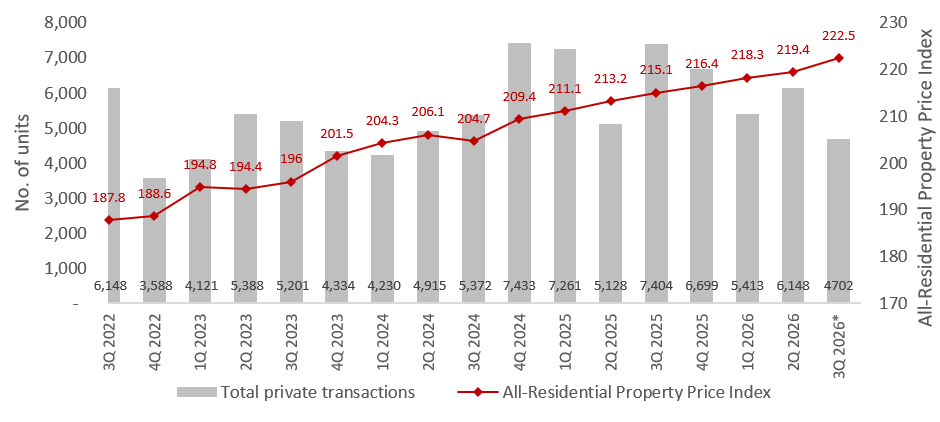
The overall non-landed private property price index (PPI) rose slightly by 0.9% q-o-q to 212.5 in 3Q 2026, following a slight dip of 0.1% q-o-q witnessed in the second quarter.
- The Outside Central Region (OCR) saw a 2.2% q-o-q increase in prices, rebounding from the 0.1% q-o-q decline in the previous quarter. This quarter’s price growth could be due to the successful launch of projects like Lentor Gardens Residences in July.
- The RCR saw a slight uptick of 0.2% in prices despite no new condominiums being launched during the quarter.
- The Core Central Region (CCR) was the only market segment which saw a dip in prices, inching down 0.1% q-o-q this quarter.
- Demand held steady for landed home prices, which increased by 2.8% q-o-q in the quarter.
The quarter recorded only three new launches, namely Lentor Gardens Residences (D26, OCR), Dunearn House (D10, CCR) and Amberwood At Holland (D10, CCR). This paled in comparison to busier periods witnessed in the latter half of last year, as well as 1Q 2026, which delivered six project launches, inclusive of two Executive Condominium (EC) projects.
Private home prices remained broadly stable in 3Q 2026, even as transaction volume has waned. The moderation in activity was largely due to seasonal factors, such as the Hungry Ghost Festival, which is a usual low period for home-viewing and subsequent homebuying activity. Additionally, the tighter launch pipeline saw fewer new project launches.
In June, the URA also released the schedule of confirmed and reserved sites under the 2H 2026 GLS exercise. With an extra 4,745 private residential units added to the 2H 2026 GLS Confirmed List, the new supply will help the Government pursue its goal of sustainable housing prices and ensuring a consistent pipeline of new homes in the coming years.
In 3Q 2026, the tender for four residential GLS sites closed, with an average of 3.8 bidders. This signifies continued developer interest in GLS sites which should translate into a larger pipeline of launches in the following year.
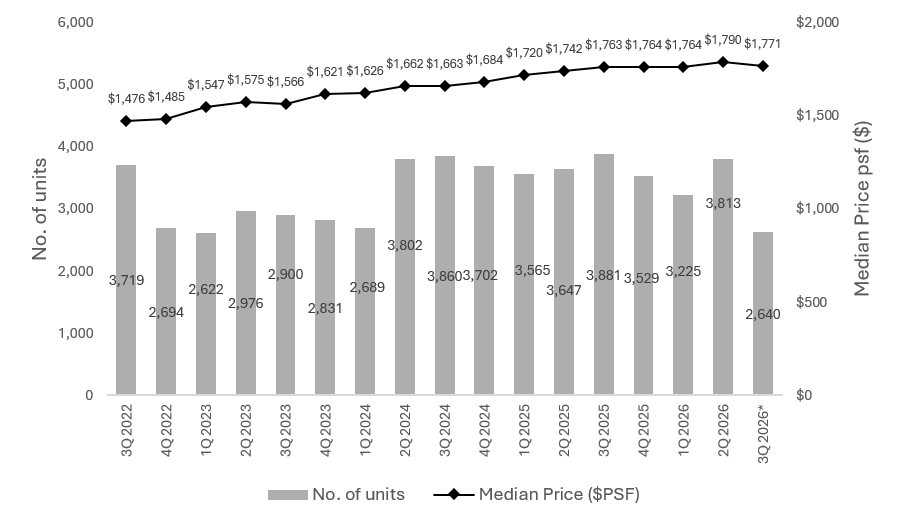
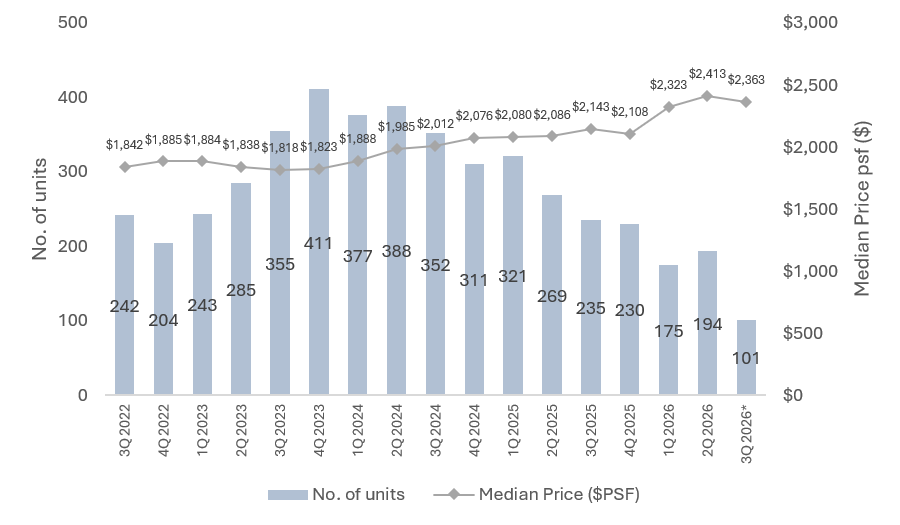
The seasonal lull also affected the resale market for condominiums, contributing to a sharp decline in transactions from 3,813 based on URA’s 2Q 2026 Quarterly Report to 2,640 caveats lodged for this quarter. Meanwhile, sub-sale transactions continued on its downward trend, falling to a low of 101 caveats lodged this quarter.
Based on caveats lodged for resale condominiums, Riverfront Residences saw the most activity this quarter with 32 transactions, followed by D’Nest (24 transactions). Normanton Park and Treasure at Tampines tied for third place with 23 transactions each.
The popularity of Riverfront Residences could be because the 99-year leasehold condominium just obtained its temporary occupation permit (TOP) in 2023. Additionally, there are a number of popular schools within a 1km radius including CHIJ Our Lady of Nativity, Holy Innocents’ Primary School and Holy Innocents’ Secondary School.
The lower number of overall transactions in the quarter led to a corresponding moderation in the price index. However, the underlying demand for homes remains strong and economic fundamentals are expected to stay resilient.
Therefore, price growth is projected to stay gradual and sustainable throughout the year. Prices are expected to sustainably remain on track to reach ERA’s earlier forecast of 3% to 5%, while transactions for non-landed private residential should remain on course to attain ERA Singapore’s projection of 9,000 and 10,000 units for the primary market, and a further expected 12,000 to 13,000 transactions in the secondary market
New Sale (Non-Landed Homes, Excluding ECs)
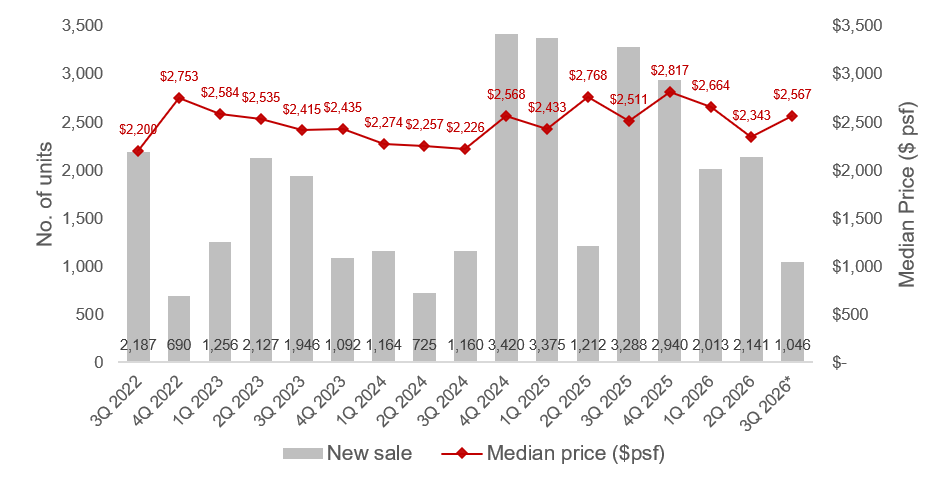
According to caveats lodged as of 1 October 2026, new sale transactions for condominiums fell sharply from 2,141 units (based on URA’s 2Q 2026 report) to 1,046 units (based on caveats lodged).
Similarly to what was observed in 2Q 2026, fewer new projects and units were launched. Approximately 1,091 private new homes were launched in 3Q 2026. Coupled with the seasonal lull observed during Hungry Ghost month, this was likely the key attributing factor to a more subdued quarter in the primary market.
Table 1: List of new launches in 3Q 2026
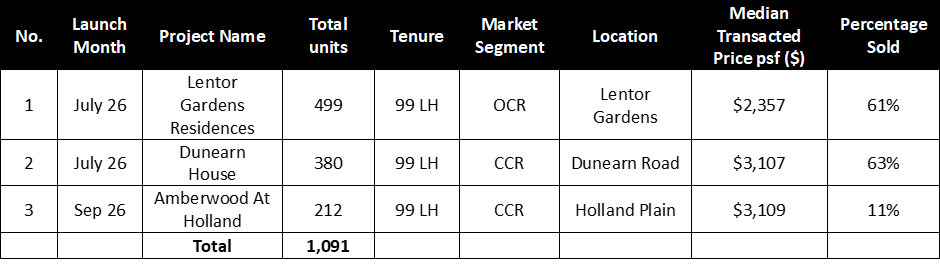
The take up rates for projects launched in the quarter were modest, at 54% for Lentor Garden Residences, 56% at Dunearn House, and 11% at Amberwood At Holland on their respective launch weekends.
Steady take-up rates across the newly launched projects in the quarter signified that underlying demand for well-located and well-positioned new homes remains firm. Projects entering the market continued to attract substantial interest, reflecting sustained buyer confidence despite global uncertainty. The positive reception for these projects fuelled the slight uptick in prices for the quarter.
Chart 2: New Sale Transactions and Median Price for Non-Landed Homes (excluding ECs)
Core Central Region (CCR)
CCR prices dipped slightly by 0.1% q-o-q in 3Q 2026, following the 1.8% q-o-q increase from the previous quarter. This is despite the launch of Dunearn House in July and Amberwood At Holland in September. The decline could be due to the high base set in the previous quarter.
The launches of Dunearn House and Amberwood At Holland this quarter marked the first project launches in the upcoming Bukit Timah Turf City and Holland Plain housing estates. These new estates are expected to inject fresh housing supply and support the rejuvenation of Singapore’s established CCR neighbourhoods.
The CCR has traditionally been a market segment coveted by owner-occupiers, given its central location, well-regarded addresses and established communities. The supply of new leasehold homes is expected to support genuine owner-occupier demand from upgraders and right-sizers seeking replacements for ageing properties in these estates, underpinned by practical and liveable layouts and competitive pricing.
Compared to 2025, the CCR market segment is expected to see lower new home supply this year. The market segment saw the launch of about 1,424 CCR units and likely no further projects or units to be added to the pipeline this year.
Buyers interested in further new CCR homes will possibly have to wait out till 2027, which could see the launches of new projects in Newton, and Turf City.
Rest of Central Region (RCR)
The RCR recorded a 0.2% q-o-q uptick in prices, following a decline of 1.2% q-o-q in the previous quarter. The slight increase could be because homes in this market segment still offer a compelling value proposition for genuine upgraders. This is supported by their relatively central locations, proximity to mature estates with established schools and amenities, and the narrowing price gap with the OCR as prices in the latter continue to rise.
This is particularly evident in District 15 (D15), which remains one of Singapore’s most sought-after upgrader locations. Despite the absence of a new project launch in the district since Emerald of Katong in 2024, steady demand for balance units at earlier launches has consistently placed D15 among the top-performing districts for new home sales.
Outside of Central Region (OCR)
3Q 2026 saw one OCR launch, Lentor Gardens Residences in July, and reported an overall 2.2% q-o-q increase in the OCR price index.
The project’s more modest take-up rate of 61% may partly reflect the six earlier launches in the same estate since 2020, which have already absorbed a steady pool of buyers. Some upgraders may also be holding back for upcoming launches in other locations.
Nevertheless, the OCR remains a market segment underpinned by a sizeable upgrader pool, particularly among HDB owners who have accumulated substantial housing equity amid a robust resale market. Its performance also points to a broader trend: buyers have become increasingly selective but remain decisive when projects meet their expectations for pricing, location and product quality.
Executive Condominium (EC)
There were no EC launches in 3Q 2026, which could explain the lower transaction volume for ECs this quarter. Majority of this quarter’s new sale volume for ECs in the third quarter is for Coastal Cabana (45 transactions) and Rivelle Tampines (16 transactions) which were launched earlier this year.
During the National Day Rally, Prime Minister Lawrence Wong announced that the monthly income ceiling for ECs has been increased from $16,000 to $18,000. The higher income ceiling will apply to all EC sites whose land tender closed on or after 24 August 2026. This increase will allow more households to be eligible to purchase a new EC from developers.
Resale and Sub-Sale (Non-Landed Homes, Excluding EC)
In 3Q 2026, resale transactions for non-landed private homes (excluding ECs) declined by 30.8% q-o-q to 2,640 units (based on caveats lodged), making the third quarter the slowest quarter so far this year. The lull in the resale market could be due to the Hungry Ghost Festival.
In line with the drop in resale transactions, the median price for non-landed private residential properties (excluding EC) dipped by 1.1% q-o-q to $1,771 psf.
Chart 3: Resale Transactions and Median Price for Non-Landed Homes (excluding ECs)
Within the sub-sale segment, transaction volumes continue to decline, falling from 194 transactions reported by URA in their 2Q 2026 report to a record low of 101 caveats lodged this quarter. The median sub-sale price also fell from $2,413 psf in the second quarter to $2,363 psf in this quarter.
Chart 4: Sub-Sale Transactions and Median Price for Non-Landed Homes (excluding ECs)
Market Outlook
According to the 3Q 2026 flash estimates, overall private property prices rose by 1.4% q-o-q. They remain on track to reach ERA’s earlier forecast of 3% to 5%.
Singapore is recognised as a safe haven amid global uncertainties, thanks to stable governance, a strong Singapore Dollar, and a resilient property market. Despite global market challenges, the residential property sector in Singapore remains largely optimistic in the near term. Over time, Singapore has built a reputation as a leading wealth hub in the region, with its real estate regarded as a high-quality asset that provides steady rental income and strong capital appreciation for investors.
One structural trend that is becoming increasingly important is the transfer of housing wealth between generations. We are seeing older homeowners right-size and unlock equity from properties that have appreciated significantly, while some younger buyers receive family support for their first or next home.
This recycling of housing wealth is creating another layer of demand in the residential market. It also helps explain why purchasing power has remained relatively resilient even as home prices and affordability pressures have increased.
In 2026, the private residential market is expected to remain resilient, supported by moderate price growth driven by strong owner-occupier demand and ongoing right-sizing trends. Healthy take-up rates from recent project launches reinforce this positive outlook. This underlying demand has also prompted developers to commit to new projects, suggesting that the development pipeline and future housing supply will continue to be supported by strong market fundamentals.
Barring unforeseen circumstances, ERA Singapore projects new home sales to be between 9,000 and 10,000 units, while the secondary market is expected to record 12,000 to 13,000 transactions, indicating stable underlying demand in the year ahead.
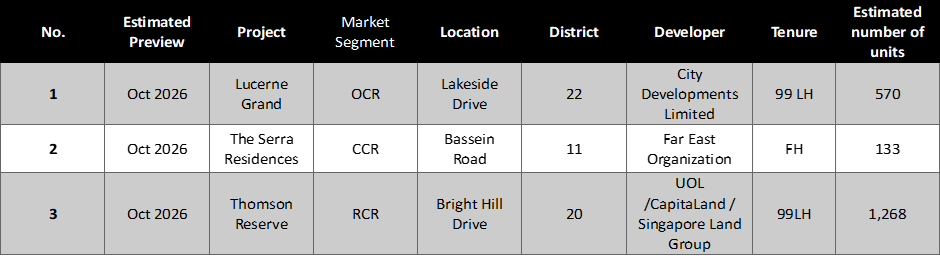
Table 4: Upcoming launches in 4Q 2026